
Overcoming battery testing limits with in-situ CT analysis
In the world of energy storage, understanding how a battery behaves under real-world conditions is the ultimate challenge. Traditional “post-mortem” analysis – disassembling a battery after it fails – only tells half the story. It’s like trying to understand a car accident by looking at a scrapyard. To truly innovate, we need to see what happens inside the cell while it is actually working.
This is where in-situ computed tomography (CT) testing becomes a game-changer. Unlike conventional methods, our specialized In-situ BOX allows for continuous 3D monitoring of batteries during active electrochemical cycling. Therefore, we are able to ‘see’ inside a working cell. By integrating environmental control directly into the micro-CT system, we can subject batteries to precise thermal loads – simulating everything from freezing winters to extreme heat, all while capturing high-resolution internal images. This “true-to-life” testing environment bridges the gap between laboratory research and real-world application.
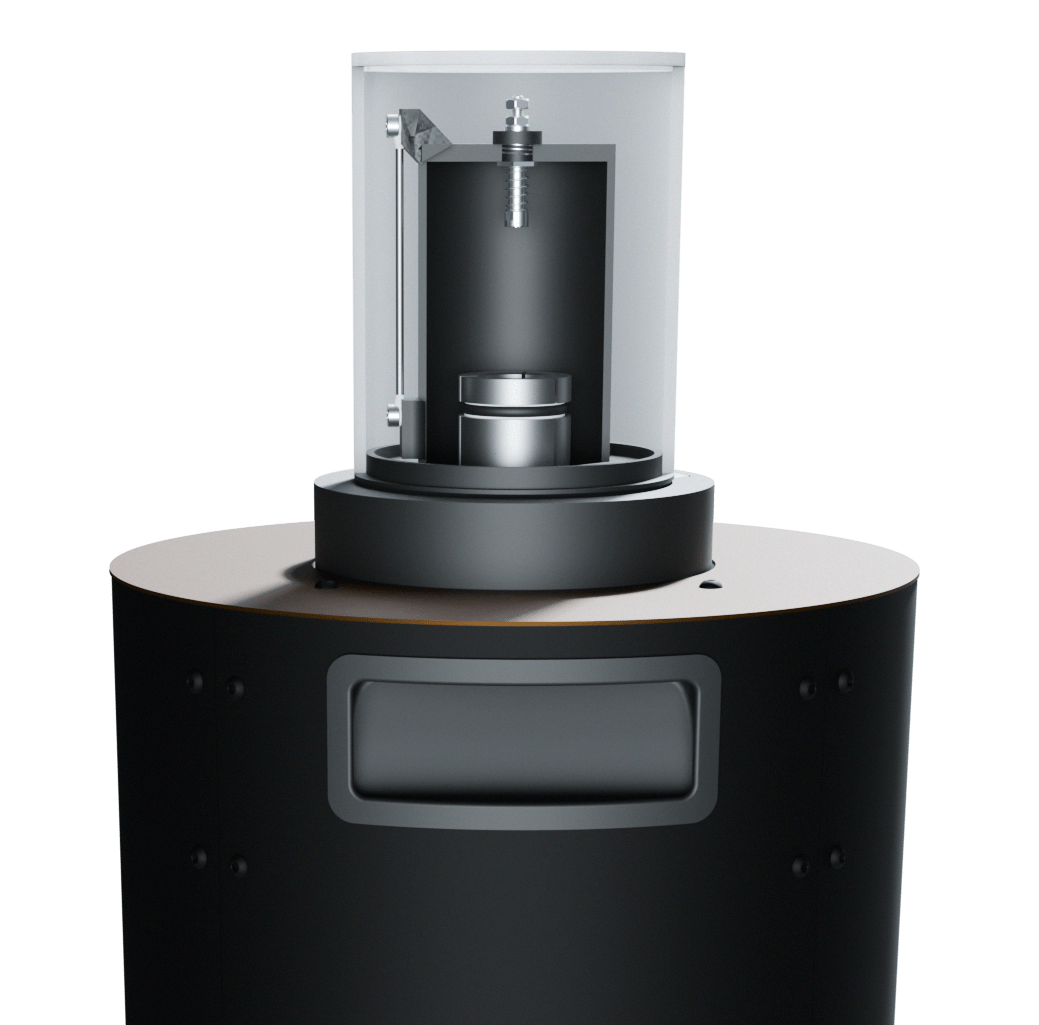
Case Study: Visualizing Electrolyte Dynamics in Panasonic Cells with in-situ CT
To demonstrate the capabilities of the in-situ CT technology, we conducted a study on commercial Panasonic NCR18650BD cylindrical Li-ion cell with a Nickel Cobalt Aluminum Oxide (NCA) cathode and a nominal capacity of 2980 mAh. This chemistry is known for good energy density but can face structural and thermal challenges at high temperatures and voltages.
The goal was to observe a process that was previously nearly impossible to track: the real-time movement and redistribution of the liquid electrolyte during discharge.
Methodology
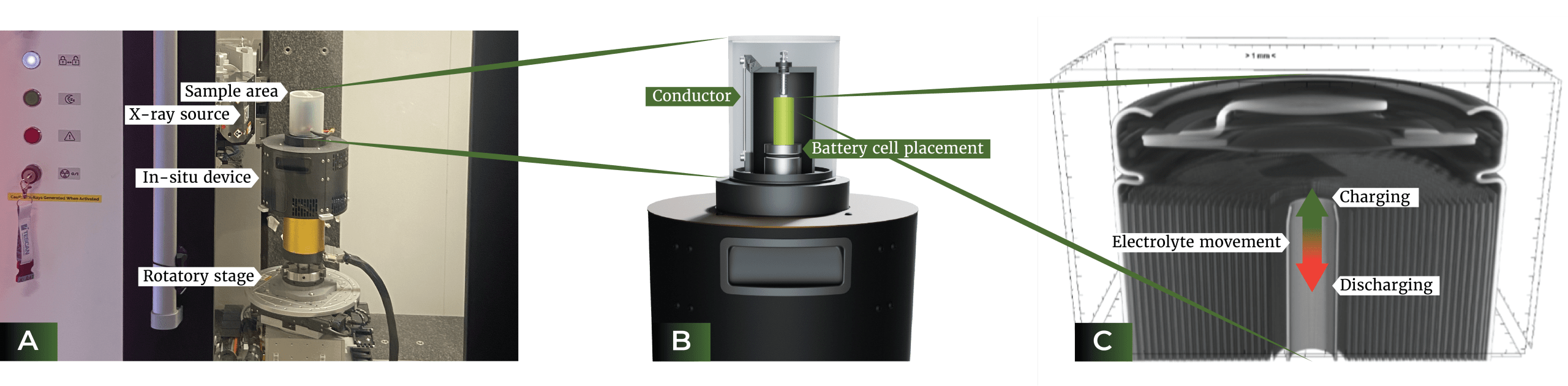
To capture these insights, we integrated our specialized In-situ BOX directly into the Tescan UniTOM XL Spectral micro-CT system. This setup allowed us to maintain a completely controlled environment while the battery was actively discharging. Instead of just taking a snapshot, we monitored the discharge cycles of the Panasonic cells at three different temperatures: -15°C, 5°C, 25°C. By using high-resolution dynamic scanning, we were able to penetrate the steel casing of the battery and record its internal behavior in 3D without ever interrupting the test or damaging the cell.
What we discovered
Our in-situ CT testing confirmed what many suspected but few could see: the liquid electrolyte physically moves and redistributes inside the cell during discharge. By comparing scans across different temperatures, we’ve visualized how heat and cold fundamentally change the battery’s internal environment.
Key takeaways from our research:
-
Direct Visual Proof: For the first time, we have 3D evidence of how the liquid electrolyte behaves. We no longer have to guess based on electrical data; we can see the “why” behind the performance.
-
The Impact of Cold: Our scans clearly show how freezing temperatures increase internal resistance and polarization. This provides a visual explanation for the rapid capacity loss we experience in winter conditions.
-
Dynamic Monitoring: The high-resolution data allowed us to track subtle internal shifts during the active discharge cycle that are completely invisible to traditional “post-mortem” testing.
These findings align with what we know about battery chemistry. Our observations of how temperature affects viscosity and conductivity match established research, but with the added value of real-time 3D evidence.
For a more detailed technical breakdown and further data on this research, you can explore the full study here.
Why use the in-situ BOX?
This technology isn’t just for academic research; it’s a powerful tool for accelerating commercial R&D. The In-situ BOX turns a standard scanner into a precise environmental chamber, allowing you to test battery prototypes under real-world stress without disassembling them. By identifying structural issues early in the design phase, you can reduce the number of failed prototypes and bring safer, more efficient batteries to market significantly faster.
Are you interested in testing your own battery cells? Kontaktujte nás today to discuss our in-situ BOX or to schedule a professional measurement for your project.