
In-situ thermal testing: Imaging soft biological tissues has always been a trade-off between resolution and preservation. Researchers need to see structural details, such as fiber orientation, without altering the very features they aim to study. In practice, this is difficult. Many conventional techniques either damage the sample or fail to provide sufficient resolution for meaningful analysis.
This is where in-situ testing steps in.
The challenge of imaging soft tissues
Fiber orientation plays a key role in determining tissue structure and function. However, capturing this organization accurately is challenging. Traditional imaging workflows often involve sample preparation steps that introduce artifacts such as shrinkage, distortion, or dehydration. As a result, the observed structure may no longer reflect the true native state of the tissue.
For researchers working in biology or biomaterials, this poses a challenge: how to observe intact structures without compromising them.
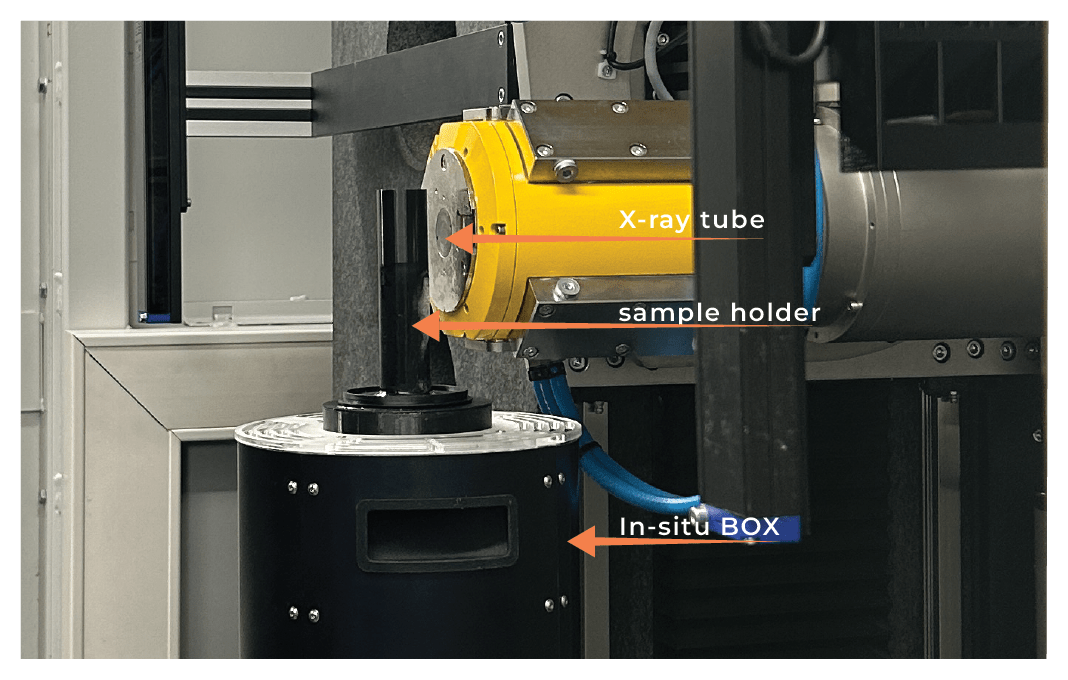
Involving dynamic 4D CT scanning
Cooperation between CactuX and CT Lab at CEITEC addresses this challenge through involving a compact in-situ CT chamber designed for precise environmental control during CT scanning. By integrating in-situ thermal testing directly into the CT workflow, samples can be rapidly frozen and maintained in that state throughout the entire measurement.
This is a crucial step. Maintaining consistent conditions during scanning prevents structural changes and ensures that what is imaged truly represents the original tissue architecture.
It enables a controlled workflow:
- Contrast enhancement (staining) to improve visibility of soft structures
- Reference scanning before treatment
- Rapid thermal conditioning, freezing
- High-resolution CT imaging within the in-situ chamber
- Analysis of the resulting data
In-situ testing: seeing what was previously hidden
Using this methodology, individual fibers, such as collagen or muscle fibers, can be clearly visualized within intact tissues. The improved contrast and preserved microstructure allow for detailed quantitative analysis, including fiber orientation, diameter, and branching.
Importantly, common artifacts associated with traditional methods are significantly reduced. This leads to more reliable data and better reproducibility across experiments.
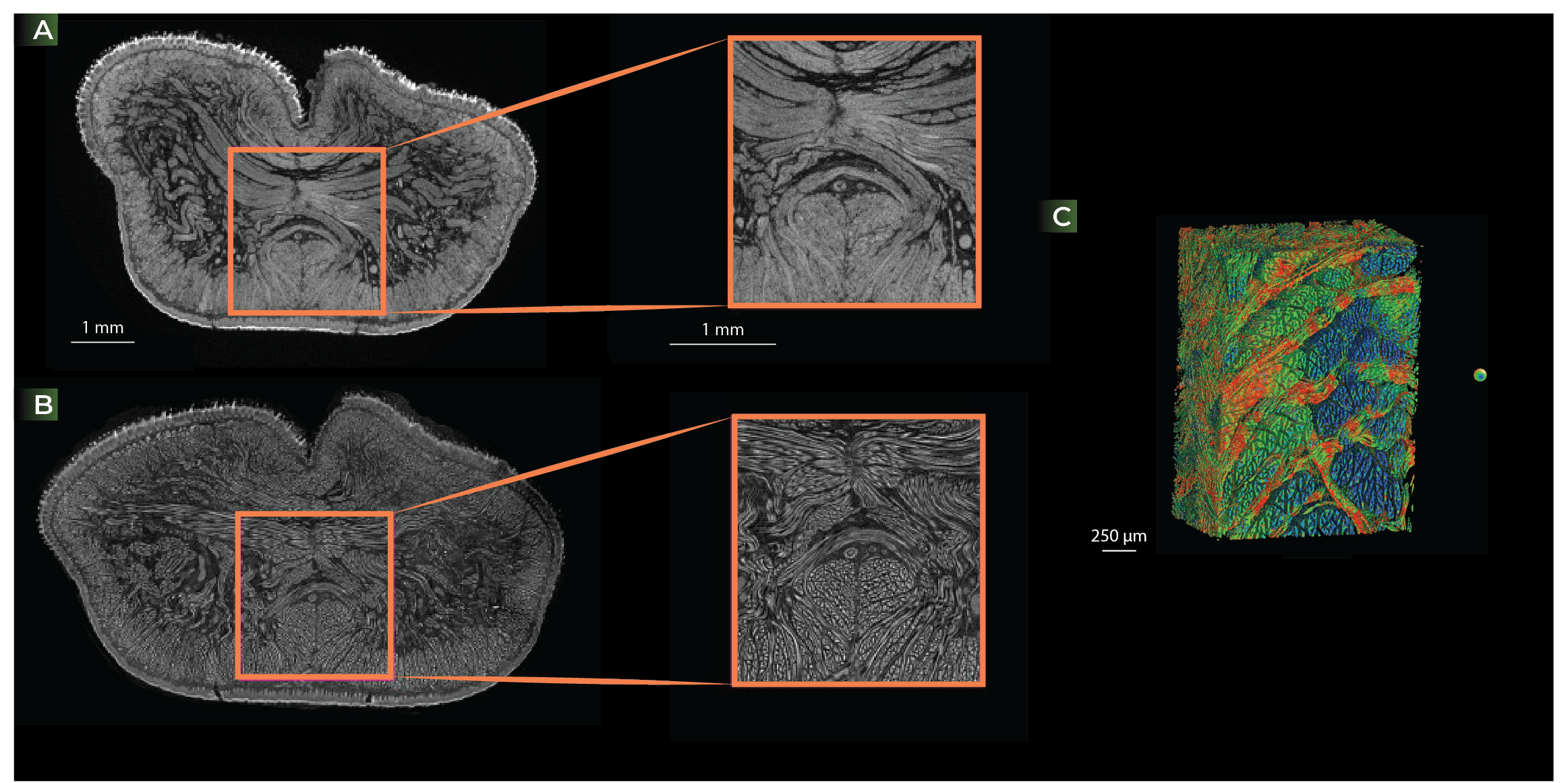
Rat tongue sample before freezing, B: Rat tongue sample after fast freezing, measured by cryo-CECT method, C – Muscle fiber diameter analysis of selected region in cryo-CECT [1] data, D – Muscle fiber orientation analysis of selected region in cryo-CECT data.Voxel size 3 μm. Data analysis was performed in VGtudio Max.
A step forward for real-time material behavior imaging
The ability to combine in-situ testing with high-resolution CT imaging represents a significant advancement for multiple fields. From developmental biology to tissue engineering and biomaterials research, the benefits are clear: more accurate data, better insight into structure-function relationships, and the ability to study materials in conditions closer to reality.
By integrating in-situ thermal testing within a compact in-situ CT chamber, CactuX and CEITEC enable a new level of precision in soft tissue imaging. This approach preserves native structure, enhances visibility, and supports advanced in-situ material characterization.
As the technology continues to evolve toward dynamic 4D CT scanning, researchers will gain even greater ability to observe and understand materials as they change.
Click for more information about compact in-situ CT chamber!
References: [1] Maes, A., et al. (2022). Cryogenic contrast enhanced microCT enables nondestructive 3D quantitative histopathology of soft tissues. Nature Communications, 13, 6207. https://doi.org/10.1038/s41467-022-34048-4
Acknowledgements: This project was done in cooperation with CEITEC – Central European Institute of technology Brno University of Technology