
Designing an in-situ chamber is always a balance of precision, stability, reliability, and versatility. That is why we engineered the standard In-situ BOX to be as adaptable and integration-friendly as possible. Measuring just 200 × 200 × 405 mm, it easily fits into your micro-CT cabinet while allowing a full 360° rotation for uninterrupted scanning.
Its core strength lies in its modularity. We designed it to serve as a reliable platform for non-destructive testing (NDT)that can be quickly configured for different research fields:
-
- Thermal BOX: For thermal testing and studying temperature-driven material behavior.
- Battery BOX: For safe active cycling (charging & discharging up to 30 A).
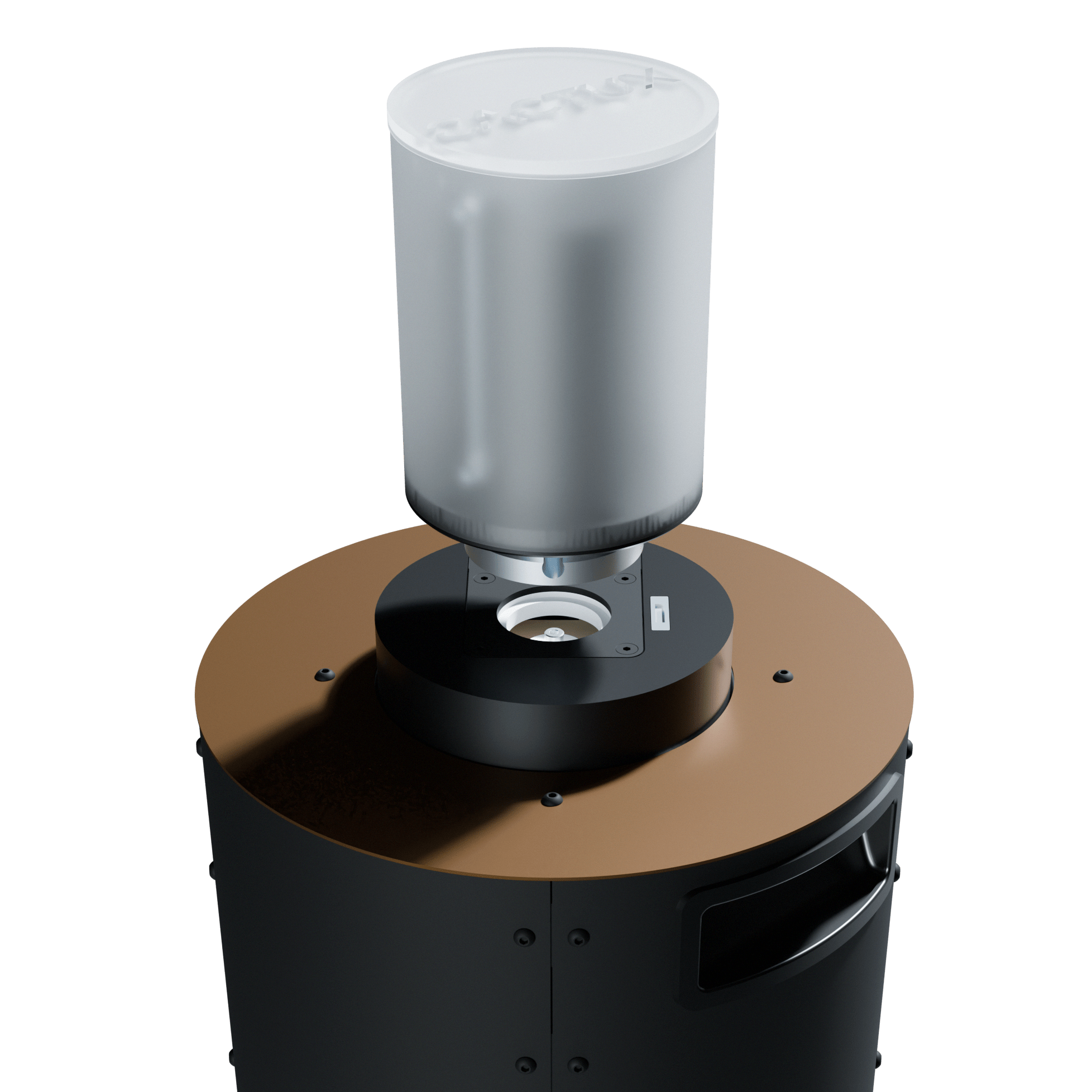
For most laboratory research, its standard climate control range of -30 °C to +60 °C is the ideal sweet spot. It allows researchers to simulate freezing winters or baking desert heat, making it easy to study liquid electrolyte movement in battery cells or the behavior of soft materials under thermal stress.
But let’s be honest: science rarely stays within “standard” boundaries.
Every now and then, a research goal requires an experiment that sounds less like a standard lab test and more like a trial by fire. When your testing demands extreme environments past our standard range, we don’t look for workarounds. We design custom high-temperature in-situ CT solutions to make it possible.
The Challenge: High-Temperature In-situ Composite Inspection
Carbon Fiber Reinforced Polymers (CFRPs) are the superstars of the aerospace and automotive industries. They are incredibly light, ridiculously strong, and usually very durable. But when they get hot – specifically, locally hot, like near an engine manifold, an exhaust, or during a lightning strike – things can go south quickly.
To perform an accurate failure analysis CT and truly understand how these materials fail, you cannot just bake them in an oven and look at the ashes afterward. You need real-time 4D CT scanning to watch the destruction happen inside the CT scanner. This requires precise localized environmental control.
For this specialized composite inspection, we designed a custom high-temperature in-situ CT BOX featuring specialized contact heating to apply temperature ramps directly to a CFRP sample while capturing high-resolution 3D CT scans. Our primary goal was to map the structural degradation from room temperature (21 °C) up to severe thermal stress at 450 °C.
Witnessing Thermal Degradation: From Sealant Failure to Core Delamination
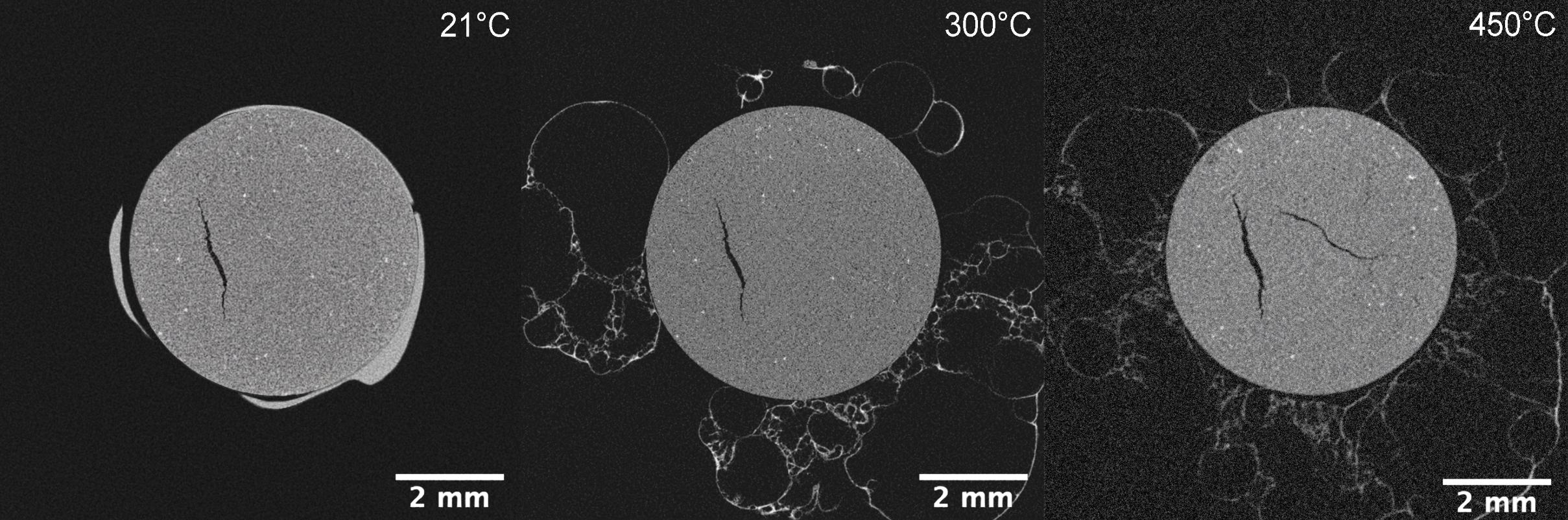
The high-resolution in-situ CT data we collected paints a clear, step-by-step picture of how intense heat systematically dismantles the sample. Rather than everything failing at once, we can watch different components yield at different temperature thresholds:
21 °C | The Baseline
At room temperature, the circular carbon rod is perfectly intact, tight, and surrounded by a thin, outer layer of sealant/glue. (Note the pre-existing hairline crack in the center, which serves as a perfect marker to watch for structural changes later on.)
300 °C | The Sealant “Pops” (But the Core Holds)
As we ramp the temperature up to 300 °C, we see a dramatic event on the perimeter:
-
- The outer sealant/glue layer has completely given way, expanding into huge, balloon-like voids.
- Interestingly, the carbon rod itself remains remarkably stable at this stage – the central circular rod and the baseline crack are virtually identical to the 21 °C scan
450 °C | Core Delamination and Matrix Pyrolysis
Once we push the temperature to 450 °C, the carbon composite core itself finally reaches its limit. We can observe two major structural changes:
-
- True Delamination: A secondary, branching crack has ripped through the core.
- Matrix Pyrolysis & Image Noise: The overall scan at 450 °C looks considerably noisier and fuzzier. This isn’t a glitch in our CT scanner – it is direct physical evidence of pyrolysis. The polymer matrix (the “glue” holding the carbon fibers together) is actively decomposing into gas at this temperature. These escaping gases build up pressure, scattering the X-ray beam and creating this distinct visual noise right before our eyes.
Bring Us Your Toughest Experiments
Whether you need to stretch it, compress it, freeze it, or blast it with 500 °C of direct contact heat, your in-situ experiments shouldn’t be limited by off-the-shelf hardware.
We built the In-situ BOX to be modular for a reason. If you have a unique material testing challenge that requires custom-built environmental controls or advanced failure analysis CT capabilities, let’s talk.